The School of the Future: When Architecture Becomes the "Third Teacher"
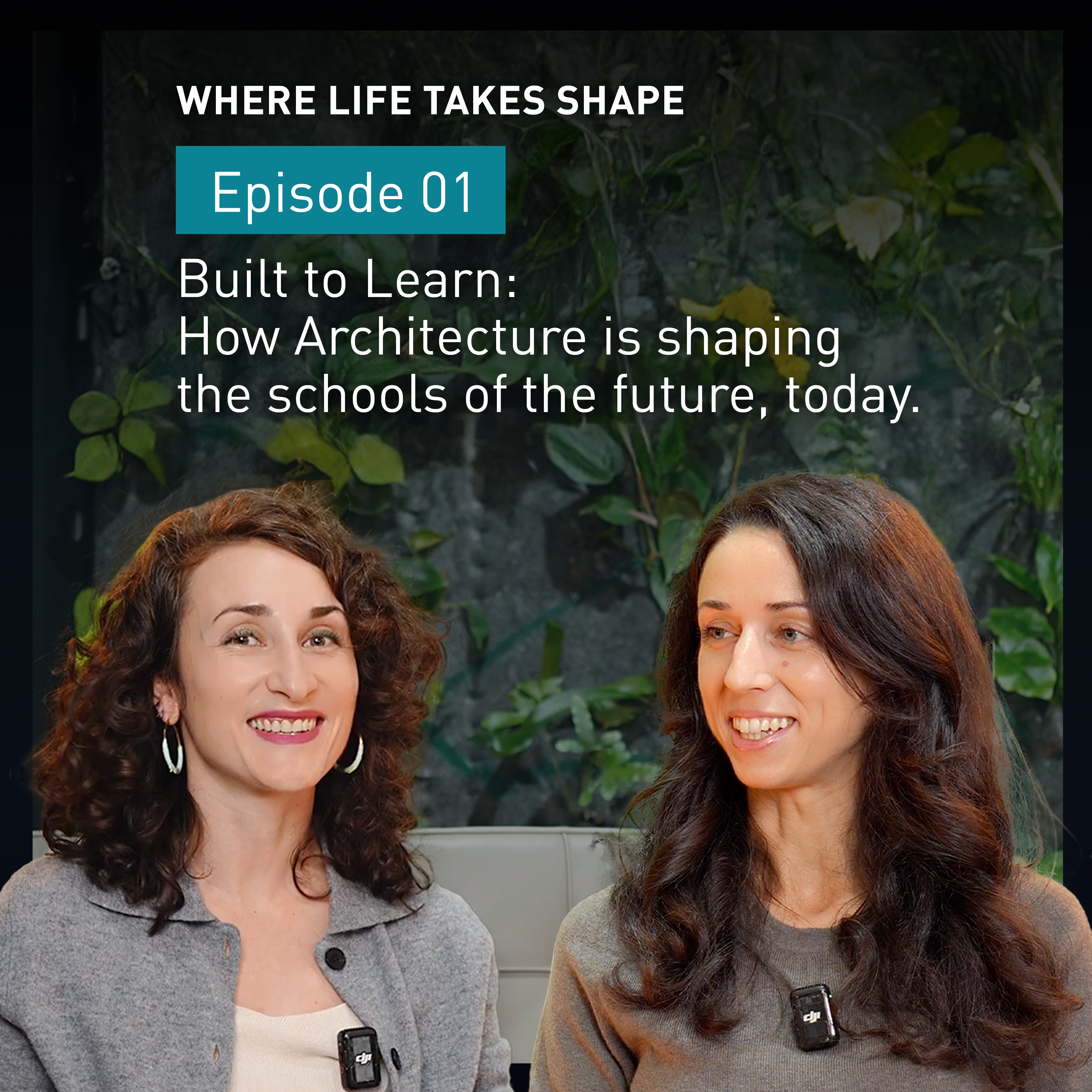
In the pilot episode of our podcast “Where life takes shape”, the SGI Architects team pulls back the curtain on the processes transforming education. Together with our experts Nezi and Veli, we analyze how architecture is evolving from a passive background into an active participant in the learning process.
This article offers a deep dive into the "anatomy" of the modern school and the social change that begins in the school corridor.
1. A Clash of Eras: Why the "Corridor School" is Dying
Many of us remember the classic school: long corridors lined with rows of closed doors. This architecture served its purpose in an era when the teacher was the sole source of information. Today, however, the teacher's role has fundamentally shifted. They are now mentors, advisors, and coordinators. To fulfill these new functions, the building itself must change. You cannot expect innovative learning in an environment designed for silence and compliance. The school building is a "product of the world" and must evolve to meet its current needs.
2. The Philosophy of "The Environment as the Third Teacher"
Modern pedagogy recognizes the concept of the three teachers: the first are the parents, the second is the educator, and the third is the environment. School is primarily a social space—the place where a child learns how to live in society. It is proven that if an environment is unmaintained or broken, it provokes aggression and vandalism. Conversely, a clean, detailed, and beautiful environment intuitively fosters respect and a desire to learn.
3. Anatomy of the Modern School: The 6 Learning Zones
To be functional, a school must offer variety. At SGI, we define 6 key zones with metaphorical names that describe different modes of learning:
I. Mountain Top – The Presentation
This is the zone for classic delivery—one speaks, many listen.
- What it looks like: A large stage, an auditorium, or a zone in the classroom where a child (or teacher) presents an idea to an audience. This develops public speaking skills.
II. Campfire – Teamwork
- Function: Group work, discussions, storytelling.
- Solution: Corners with furniture that allows small groups to work together ("around the fire").
III. Cave – Concentration
In the noisy world of school, children need solitude.
- Function: A quiet place for homework or reading.
- Solution: Small niches, "dens," or soundproof corners in the library and corridors.
IV. Watering Hole – The Social Hub
The place where everyone gathers.
- Function: Socialization, dining, communication.
- Solution: Foyers and the cafeteria. The dining area is no longer just a "canteen" but a restaurant-style space that is adaptive and can host events.
V. Movement – Activating the Body
A child's brain learns best when the body is active.
- Solution: Sports are not limited to the gym. Corridors can feature "track" flooring for running or pull-up bars where children can burn off energy between classes.
VI. Hands-on – The Laboratories
Learning by doing—touching and creating something with your hands. This includes STEM centers and workshops.
4. Decoding STEM, STEAM, and STREAM
The term STEM is everywhere, but what does it really mean?
- STEM: Science, Technology, Engineering, Math.
- STEAM: Adds Art.
- STREAM: Adds Reading.
This means a good center includes a library or reading corner. Architecturally, it is often divided into two zones:
- Clean Zone: Computers, 3D printers, robotics.
- Dirty Zone (Maker Space): A workshop with tools, hammers, and paints—a place to get messy and create.
The key is connectivity. Physics and Biology labs should not be isolated. They can be merged via movable walls to teach integrated lessons.
5. The Psychology of Detail: Toilets and Corridors
Toilets are a critical zone for a student's psyche. Because they are hidden, they are often where aggression occurs. The Solution: The sink area is moved out into the corridor—becoming open and visible. This improves hygiene and social control. The cubicles themselves become fully enclosed rooms, ensuring complete privacy to eliminate stress and fear. Corridors, in turn, cease to be mere transport belts. They become destinations—places for socialization, learning, or play.
6. The "Nestle Effect": How Do We Change Society?
In the podcast, we share a telling story. After WWII, Nestle tried to introduce coffee to Japan—a tea-drinking nation. Initially, they failed. Then they changed strategy: they started selling coffee-flavored desserts to children. The children got used to the flavor, and when they grew up, they sought out coffee as a beverage. Today, Japan is a massive coffee market. The Connection to Schools: The easiest way to change a society is to start with the children. If we create schools today that are beautiful, functional, and organized, we are raising a generation that will demand such an environment everywhere around them tomorrow.
Conclusion: There Is No Finish Line
The ideal school is not a static goal. The design process changes continuously because our way of life changes. "There is no finish line... there is always a change that follows." Our task as architects, parents, and teachers is to provide an environment that doesn't just house children but inspires them. Because everything starts there. Listen to the full conversation on the transformation of education in the first episode of the “Where life takes shape” podcast.
Where To Next?
- Article
Living Architecture
In today’s world of constant hurry, architecture has become obsessed with newness and perfection. In the pursuit of making things perfect for the eye, we sometimes forget to consider how to make them appealing to the other senses. In doing so, we miss the chance to create emotion and atmosphere.
24 July 2025 - Article
From the K&D Cup to Wimbledon
Just one year ago, Ivan Ivanov and Alexander Vasilev were competing in the K&D Cup at Tennis Club Diana in Sofia — a home-ground tournament powered by belief in young Bulgarian talent. Now, they’ve made history. Ivanov has just been crowned Junior Wimbledon Champion, and Vasilev reached the semi-finals.
14 July 2025